
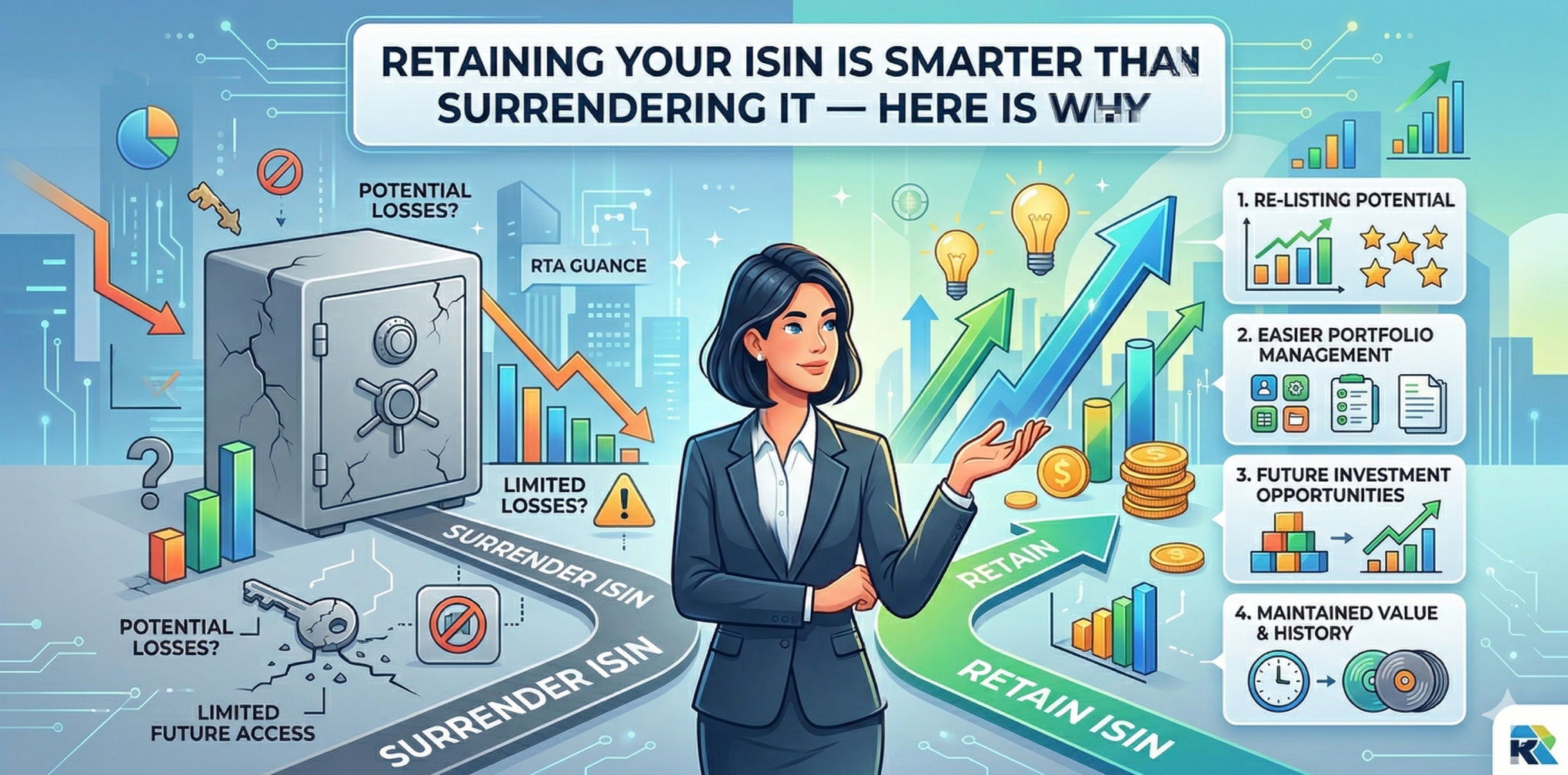
The Case Against ISIN Surrender Under the Revised Small Company Framework
The MCA's upward revision of the Small Company definition — now covering entities with paid-up share capital up to ₹10 crore and turnover up to ₹100 crore — has been widely welcomed. For many unlisted companies and AIF-linked entities, this translates into reduced filing obligations and a lighter compliance calendar.
What concerns us at NextGen Registry, however, is a pattern we are increasingly observing: companies using this reclassification as a trigger to surrender their ISIN, treating it as one more compliance item they can now do away with.
As a Registrar and Share Transfer Agent working closely with unlisted companies and Alternative Investment Funds, we believe this is one of the most avoidable mistakes a company can make.
Why the Revised Definition Does Not Make ISIN Surrender Logical
The new Small Company thresholds (effective 1st December 2025) simplify how companies are governed and reported upon. They do not, however, change the fundamental role that an ISIN plays in a company's securities infrastructure.
Compliance simplification and securities identification serve entirely different purposes. Conflating the two is where companies go wrong.
Common Justifications — and Why They Fall Short
We regularly hear these reasons from companies considering ISIN surrender:
1). "Our securities activity is minimal right now." Minimal activity today does not mean zero activity tomorrow. Preference shares, debentures, ESOPs, and convertible instruments can emerge at any stage — and each requires a valid ISIN.
2). "Small Company status means fewer obligations." Fewer statutory obligations do not mean your investors, auditors, and depositories no longer need your securities to be properly identified.
3). "Surrendering saves us money." The cost of maintaining an ISIN is negligible compared to the time and expense of reapplying — particularly when a fundraise or corporate action is already in motion.
The Real Cost of Surrendering Your ISIN
1. You Lose a Permanent, Recognised Identity for Your Securities
An ISIN is not merely a compliance requirement — it is a unique, internationally recognised identifier for your company's securities. Once surrendered, that identity is gone.
For companies that interact with institutional investors, family offices, or depository participants, the absence of an ISIN raises immediate credibility questions. Maintaining it, by contrast, signals that your securities infrastructure is intact and professionally managed.
2. Capital Raising Becomes Unnecessarily Complicated
Capital requirements are rarely predictable. A new investor, a rights issue to existing shareholders, or a fresh tranche of debentures can arise within weeks. Without an active ISIN, your company will need to:
1). File a fresh application with the relevant depository (NSDL or CDSL)
2). Submit updated corporate documentation and board resolutions
3). Wait through processing timelines that can stretch into weeks
4). Risk delays in allotment and demat credit to investors
Every one of these steps is avoidable simply by retaining the ISIN you already have.
3. Your Securities Register Loses Continuity
At NextGen Registry, maintaining a clean and continuous securities register is central to everything we do as your RTA. An active ISIN underpins:
1). An accurate, auditable cap table at all times
2). Seamless tracking of historical issuances and transfers
3). Clear records for statutory auditors and SEBI inspections
4). Smooth reconciliation between physical records and depository data
Surrendering your ISIN creates a break in this continuity — one that is difficult and expensive to repair, especially when regulatory scrutiny is high.
4. Investor Perception Takes a Hit
Sophisticated investors — particularly those in the AIF space — pay close attention to how a company manages its securities infrastructure. An ISIN surrender can signal:
1). A step back from structured governance
2). Reduced readiness for future capital activity
3). A lack of long-term institutional thinking
Retaining your ISIN, on the other hand, reinforces that your company is professionally managed, investment-ready, and forward-looking — irrespective of its current size classification.
5. Reapplication Is Far More Painful Than Retention
Once an ISIN is surrendered, the path back is not straightforward. Reapplication typically involves:
1). Complete re-verification of corporate documents
2). Fresh board resolutions and updated shareholding records
3). New depository approvals and RTA coordination
4). Potential delays during time-sensitive corporate actions
The companies that feel the sharpest pain from this are invariably those in the middle of a fundraise or restructuring — situations where speed and operational readiness matter most.
Our Advice as Your RTA
At NextGen Registry, we have supported companies through ISIN applications, dematerialisation, corporate actions, and ongoing securities management across varied structures. Our position is consistent:
> The cost of retaining your ISIN is a fraction of the cost — financial, operational, and reputational — of surrendering it and starting over.
The MCA's revised Small Company framework is a genuine relief measure. Use it to simplify your filings, reduce your reporting burden, and ease your governance load. But do not let it become a reason to dismantle the securities infrastructure that keeps your company credible and capital-ready.
Conclusion
Reclassification as a Small Company is an opportunity to operate more efficiently — not an invitation to step back from sound securities management.
Retaining your ISIN is the smarter, more strategic choice. It keeps your company:
1). ✅ Ready for any future capital raise or corporate action
2). ✅ Compliant with depository and RTA record-keeping standards
3). ✅ Credible and professional in the eyes of investors and regulators
4). ✅ Free from the time and cost of reapplication when it matters most
Your ISIN is an asset. Treat it as one.
To understand how NextGen Registry can help you manage your ISIN, securities register, and RTA compliance — reach out to our team today.
#ISIN #ISINManagement #SmallCompanyDefinition #MCA2025 #RTAServices #RegistrarAndShareTransferAgent #UnlistedCompanies #AlternativeInvestmentFunds #NextGenRegistry #Dematerialisation #CapTable #SEBICompliance #CorporateGovernance